How 5G NR Powers High-Frequency Vehicle Sensor Data
Aug 25, 2026 Resolute Dynamics
A modern vehicle generates far more sensor data than older networks could ever move in real time. Cameras, lidar, radar, and high-rate telemetry produce streams that are both large and time-sensitive, and capturing them off the vehicle as they happen needs a network that is fast, high-capacity, and reliable at the same time.
5G New Radio was built for exactly this, through service modes designed for high throughput and low latency together. This guide explains what high-frequency sensor capture demands and how the capabilities of 5G NR meet each demand.
What High-Frequency Sensor Capture Demands From a Network
Capturing high-frequency sensor data in real time places four demands on the network at once: high throughput, low latency, high reliability, and support for many devices. Older networks could meet one or two, but not all four together, which is why rich sensor streams stayed on the vehicle.
Throughput carries the sheer volume of camera and lidar data. Low latency delivers time-critical readings while they still matter for a driving decision. Reliability makes sure safety data arrives every time, not most of the time.
Device density lets a fleet connect many sensors and many vehicles in the same area without the network buckling. 5G NR is defined around meeting all four.
The 5G NR Capabilities That Make It Possible
5G NR meets these demands through three service scenarios and a set of supporting features. The 3GPP standard defines three usage scenarios, and together with edge computing and spectrum choices they cover the full range of sensor-capture needs.
eMBB: Bandwidth for High-Volume Streams
Enhanced Mobile Broadband provides the high data rate that large sensor streams need. Camera and lidar feeds produce heavy, continuous data, and eMBB is the scenario built for exactly this kind of high-throughput content. It is what makes streaming rich sensor data off the vehicle practical rather than something a fleet has to store and offload later.
URLLC: Low Latency and Reliability for Time-Critical Data
Ultra-Reliable Low-Latency Communication delivers safety-critical data fast and almost every time. URLLC is designed for single-digit millisecond latency and up to 99.999% reliability, which is why it is treated as the key enabler of connected and autonomous driving. For sensor data that feeds an immediate decision, this combination of speed and dependability is the point.
mMTC: Connecting Many Sensors at Once
Massive Machine-Type Communication supports very large numbers of connected devices in one area. A fleet is not one sensor but thousands across many vehicles, and mMTC is the scenario built for that density. It keeps the network stable when many devices report at the same time.
mmWave and Sub-6 GHz Spectrum
5G NR uses two spectrum ranges that trade bandwidth against range. Millimeter-wave spectrum, from about 24 to 52 GHz, offers enormous bandwidth, up to several gigahertz, for the highest data rates, but it suffers from path loss and blockage over distance. Sub-6 GHz spectrum carries less data but travels farther and penetrates better. A capture design uses each where it fits.
Edge Computing
Multi-access edge computing processes data close to the vehicle instead of sending everything to a distant data center. Moving computing resources to the network edge cuts the distance the data travels, which minimizes latency and enables real-time services. Heavy sensor data can be processed at the edge, with only the results sent onward.
Network Slicing
Network slicing reserves a dedicated slice of the network for a specific need. A fleet can run safety-critical sensor data on a slice with guaranteed low latency and reliability, separate from the slice carrying routine telemetry. This keeps critical capture protected even when the wider network is busy.
NR-V2X and Extended Sensors
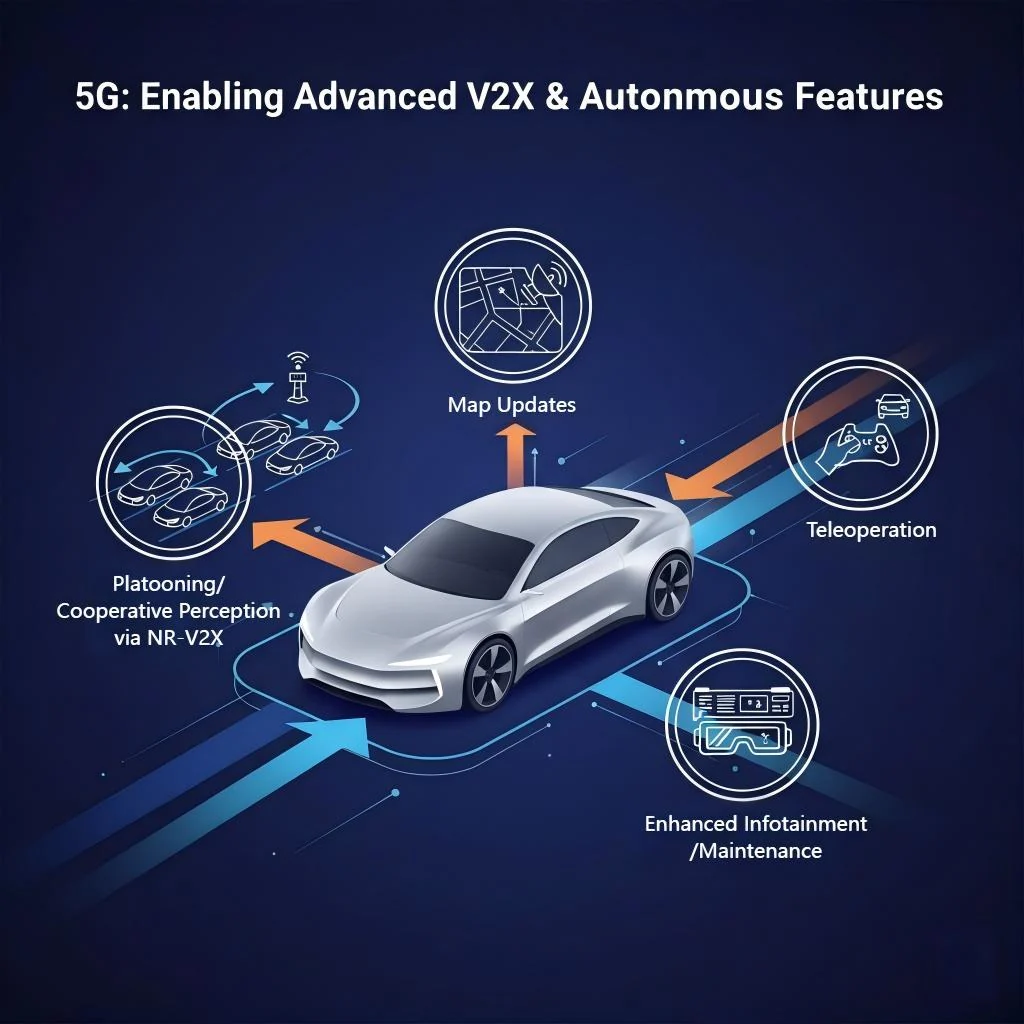
5G NR extends sensor capture beyond a single vehicle through vehicle-to-everything communication. Cellular V2X has evolved through successive 3GPP releases to add capabilities aimed squarely at automated driving.
Among the V2X applications the standard defines, extended sensors let vehicles and roadside units share captured sensor data with each other. This cooperative perception means a vehicle can effectively see beyond its own sensors, using data captured by others nearby. Alongside platooning, advanced driving, and remote driving, it turns sensor capture from a per-vehicle task into a shared, networked one.
What 5G NR Changes for Fleet Data Capture
For a fleet, 5G NR turns rich sensor data from something stored for later into something captured live. The practical change is that high-frequency streams can leave the vehicle in real time rather than waiting to be offloaded.
This opens several capabilities at once. A fleet can stream camera and sensor data to a vehicle data capture platform as events happen, run heavy analysis at the edge instead of on limited in-vehicle hardware, and support remote monitoring or operation where latency once made it impossible.
It also allows far richer telematics, since the network can carry detailed data that older connections forced a fleet to summarize or drop.
5G NR vs 4G LTE for Sensor Data
Against 4G LTE, 5G NR offers higher throughput, lower latency, and greater reliability. LTE can carry basic telematics well, but it was not built to stream high-frequency sensor data with the speed and dependability that safety functions need.
The gap shows most in demanding cases. High-automation driving calls for latency under about 10 milliseconds, very low error rates, and data rates above a gigabit per second, at vehicle speeds up to 250 km/h. These sit at the edge of what LTE can do and within what 5G NR was designed for, which is why sensor-heavy applications moved to 5G.
Practical Considerations
Adopting 5G NR for sensor capture means planning around coverage, spectrum, and cost. The technology is capable, but real deployments have to account for its limits.
Millimeter-wave delivers the highest rates but over short, easily blocked ranges, so a fleet cannot rely on it everywhere and needs sub-6 GHz and LTE fallback for continuity.
Not all telematics needs full 5G either; reduced-capability NR, aimed at higher-end telematics, offers a lower-cost option for sensors that do not need the full data rate. Matching the connection to each sensor’s real need keeps a deployment both capable and affordable.
Frequently Asked Questions
Why does high-frequency sensor data need 5G?
High-frequency sensor data needs 5G because it is large, fast, and time-sensitive all at once. Camera and lidar streams demand high throughput, and safety data demands low latency and high reliability. 5G NR is built to provide all of these together, which older networks could not.
What are the three service types of 5G NR?
5G NR defines enhanced mobile broadband, ultra-reliable low-latency communication, and massive machine-type communication. eMBB carries high-volume data, URLLC carries fast and reliable safety data, and mMTC connects large numbers of devices. Vehicle sensor capture draws on all three.
How does URLLC help vehicle sensor capture?
URLLC helps by delivering time-critical data with very low latency and very high reliability. It targets single-digit millisecond latency and up to 99.999% reliability, which suits sensor data that feeds an immediate driving decision. This is why it is seen as a key enabler of autonomous driving.
What is the role of edge computing in 5G sensor capture?
Edge computing processes sensor data near the vehicle instead of at a distant data center. The shorter distance cuts latency and enables real-time services, so heavy data can be analyzed at the edge with only the results sent on. It is central to handling high-frequency data quickly.
Is 5G NR better than 4G for fleet telematics?
For high-frequency sensor data, 5G NR is clearly better, with more throughput, lower latency, and higher reliability. 4G LTE remains fine for basic telematics, but it cannot stream rich sensor data with the performance safety functions need. Many fleets use 5G for sensor-heavy work and keep LTE as a fallback.