Capturing Emissions and Air Quality Data From Fleets
Sep 26, 2026 Resolute Dynamics
A commercial fleet vehicle can capture two very different things, and they are easy to confuse. One is the emissions the vehicle produces at its own tailpipe. The other is the quality of the air it drives through, which the vehicle did not create.
Both matter for compliance, ESG reporting, and cleaner cities, but they need different sensors and serve different purposes. This guide separates the two, then covers what each one captures, how it is captured, and what a fleet does with the result.
Emissions vs Air Quality: Two Different Data Streams
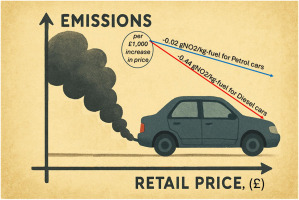
The two streams answer two different questions: what the vehicle emits, and what the air around it is like. Keeping them separate is the first step to capturing either one well.
| Emissions data | Air quality data | |
|---|---|---|
| Measures | What the vehicle produces | The ambient air it passes through |
| Examples | CO2, NOx, particulates | PM2.5, PM10, NO2, ozone |
| Main source | OBD data and exhaust sensors | External air sensors |
| Main purpose | Compliance, carbon reporting | Pollution mapping, city air |
Emissions data tells a fleet how clean its own vehicles are. Air quality data tells it how clean the streets are. A vehicle can capture both at once, but the two never substitute for each other.
Capturing Emissions Data
Emissions capture measures what the vehicle emits, led by CO2, NOx, and particulate matter. Most of it can come from data the vehicle already produces, which is what makes fleet-wide capture affordable.
What to Capture
The key emissions to capture are carbon dioxide, nitrogen oxides, particulate matter, carbon monoxide, and unburned hydrocarbons. CO2 is the headline number for carbon reporting, while NOx and particulates are the pollutants that drive air-quality rules. Together they describe both the climate and the health impact of a vehicle.
Estimating CO2 From Fuel and OBD
CO2 is captured by working it out from fuel consumption rather than measuring it directly. Because the carbon burned in fuel becomes CO2, a carbon-balance calculation turns fuel use into a CO2 figure. The OBD port supplies the inputs, including engine fuel rate and mass air flow, so a fleet can estimate CO2 for every vehicle without any extra hardware.
Capturing NOx and Particulates
NOx and particulates are captured from dedicated sensors or estimated from engine data. A vehicle may carry a NOx sensor and report the status of its diesel particulate filter and SCR system, and machine-learning models can also estimate NOx from ordinary OBD engine features. One caution: commercial NOx sensors are less reliable than laboratory analyzers and drift with temperature, humidity, and pressure, so their readings need care.
OBD Remote Monitoring vs PEMS
There are two ways to capture emissions: reference-grade PEMS, and scalable OBD remote monitoring. A Portable Emissions Measurement System is the accurate, real-driving benchmark, but it is costly and limited, so it cannot be fitted across a whole fleet. Remote OBD monitoring scales to large numbers of vehicles in near real time, which is why it fits fleet-wide capture even though it trades some precision for reach.
Capturing Air Quality Data
Air quality capture measures the ambient air the vehicle drives through, such as fine particulates and nitrogen dioxide. This needs sensors that face outward, reading the environment rather than the exhaust.
What to Capture
The main air-quality readings are fine and coarse particulates, nitrogen dioxide, and ozone. PM2.5 and PM10 track the particle pollution that harms health, while NO2 and ozone track the gases that build up in traffic. These are the same measures a city uses to judge its air.
Vehicles as Mobile Air-Quality Sensors
A fleet becomes a network of moving air-quality sensors when its vehicles carry external monitors. Fixed monitoring stations only measure a few points in a city, but a fleet drives everywhere, so its readings can build a hyperlocal map of pollution street by street. The more the fleet drives, the finer the picture.
How the Data Becomes Useful
Raw readings become useful when they are geotagged, aggregated across the fleet, and turned into trends and reports. A single number matters little; the value is in the pattern across vehicles, routes, and time.
Each reading is tagged with where and when it was taken, then combined with the rest of the fleet’s data. A vehicle data capture platform aggregates emissions and air-quality data from every vehicle, tracks it over time, and produces the totals and maps a fleet needs for reporting and decisions. That aggregation is what turns scattered sensor readings into a carbon report or a pollution map.
What Fleets Do With Emissions and Air Quality Data
Fleets use this data to report, comply, maintain, and contribute to cleaner cities. The same capture serves several goals at once.
ESG and Carbon Reporting
The data provides the CO2 numbers behind ESG and carbon reporting. Instead of rough estimates, a fleet reports emissions built from real fuel and engine data. This grounds a decarbonization plan in evidence and tracks progress over time.
Emission-Standard and Low-Emission-Zone Compliance
The data helps prove compliance with emission standards and low-emission zones. Cities increasingly restrict higher-emitting vehicles, and captured emissions data shows which vehicles meet the rules and where. It turns compliance from a guess into a record.
Spotting High-Emitting Vehicles and Maintenance Needs
The data flags vehicles that emit more than they should, which often signals a fault. A rising NOx reading or a struggling particulate filter points to a maintenance issue, so capturing emissions doubles as an early warning. Fixing the worst emitters cuts both pollution and cost.
Contributing to City Air-Quality Maps
The air-quality data lets a fleet contribute to the wider picture of city air. Detailed, located readings are valuable to municipalities and smart-city programs, and a fleet that already collects them can share them. This makes the fleet part of the solution to urban air pollution.
What Affects Accuracy
Accuracy depends on sensor drift, whether a value is measured or estimated, and calibration. Emissions and air-quality data both need this care to be trustworthy.
Low-cost sensors drift over time and with the weather, so they need regular calibration to stay honest. Estimated values, like CO2 from fuel or NOx from engine data, are practical at scale but less exact than a laboratory measurement, and a fleet should treat them as strong estimates rather than certified figures. Knowing which readings are measured and which are modelled keeps the reporting credible.
Getting Started
A fleet starts by deciding which data it needs, using OBD where possible, adding sensors where required, and aggregating everything. Beginning with the data a compliance or ESG goal demands keeps the effort focused.
- Decide the goal, whether carbon reporting, compliance, or air mapping.
- Capture emissions from OBD for CO2 and engine-based estimates across the fleet.
- Add exhaust or external sensors where direct pollutant or air-quality data is needed.
- Aggregate and calibrate the data on one platform for reliable reporting.
Frequently Asked Questions
What is the difference between emissions and air quality data?
Emissions data is what the vehicle produces at its tailpipe, while air quality data is the state of the air around it. Emissions come from OBD and exhaust sensors; air quality comes from external sensors. They serve different purposes and never replace each other.
How do you measure CO2 from a fleet vehicle?
CO2 is usually calculated from fuel consumption rather than measured directly. Because burned fuel becomes CO2, a carbon-balance method turns OBD fuel and air-flow data into a CO2 figure. This lets a fleet estimate CO2 for every vehicle without extra hardware.
Can you capture emissions without expensive test equipment?
Yes. OBD remote monitoring captures emissions across a whole fleet without costly lab or PEMS equipment. A Portable Emissions Measurement System is more precise but too expensive to fit on every vehicle. OBD-based estimates trade some accuracy for the reach a fleet needs.
How accurate are on-board NOx sensors?
On-board NOx sensors are useful but less reliable than laboratory analyzers. They drift with temperature, humidity, and pressure, so their readings need calibration and care. Many fleets pair or replace them with model-based estimates from engine data.
Can fleet vehicles measure city air quality?
Yes. With external air sensors, fleet vehicles act as mobile monitors of city air. Because they drive everywhere, they can map pollution far more finely than fixed stations. That data is valuable to the fleet and to smart-city programs.